Back in the mid 1970s, Tomatin, with a then record total of 23 pot stills, could turn out as many as 12 million litres of alcohol per annum, more than any other whisky distillery. But the Highlands producer, which lies 16 miles south-east of Inverness, has since undergone a transformation from concentration on bulk blending to top quality single malts.

Its stunning location at over 1,000 feet above sea level on the Findhorn River in the Monodhliath Mountains, as well as its collection of old and rare whiskies dating back to the 1960s, makes it an absolute must for any whisky tourist going to Speyside. It was little surprise to hear that around 30,000 people visit it each year.
Although Tomatin is just outside Speyside (which is technically a sub-region of the Highlands in any case), its whiskies mirror the soft, fruity and elegant Speyside style. They are anything but rugged and robust, as one would expect from a Highland malt, which explains the motto on their packaging of “The softer side of the Highlands.”

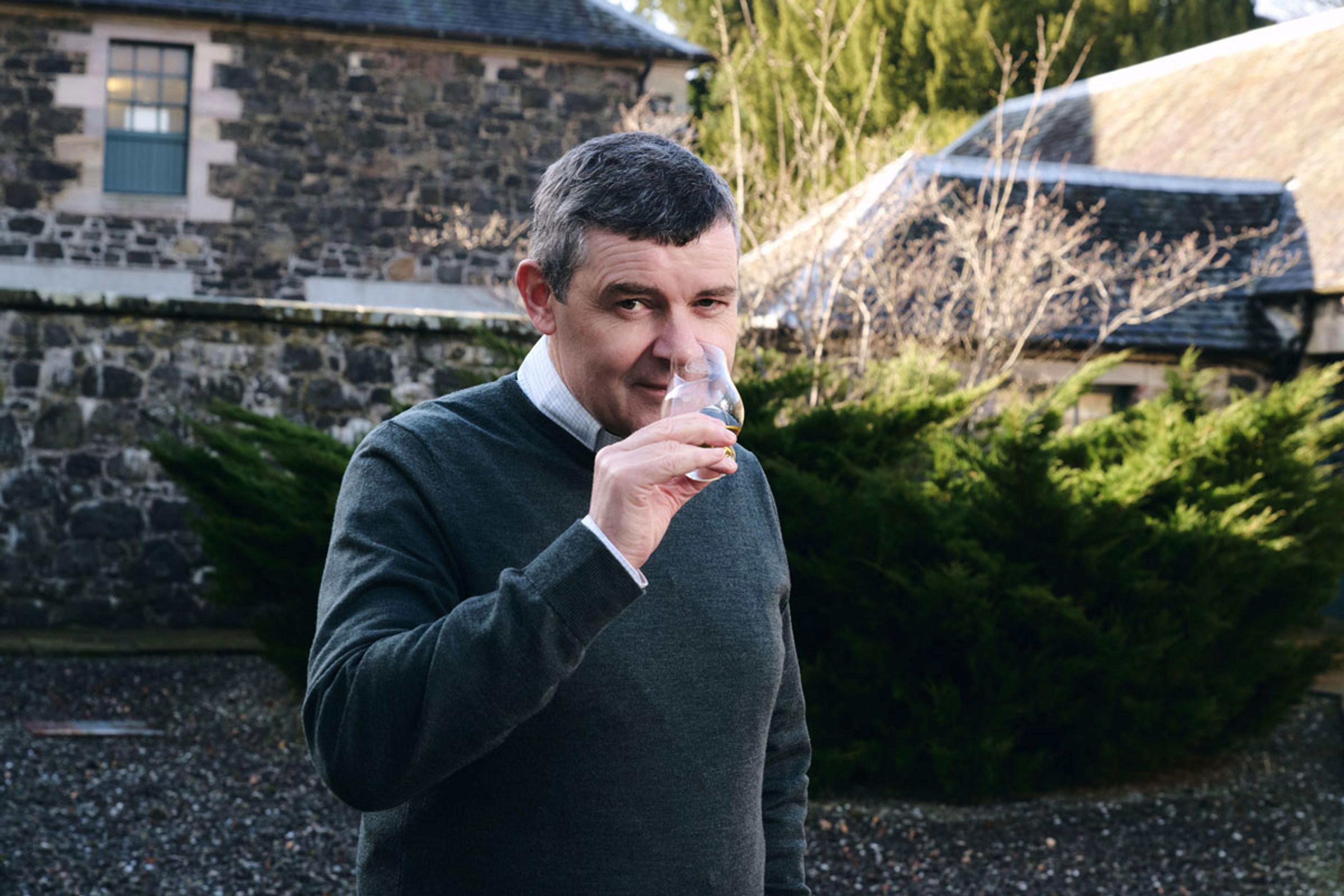
Jamie Muir, Tomatin’s distillery manager
Jamie Muir, Tomatin’s distillery manager for the past two and a half years, is as engaging a host as he is highly capable leader of the production team. With senior roles previously at three well-known distilleries - Isle of Jura, Fettercairn and Kilchoman - he has extensive experience, although other key figures have been working at Tomatin for decades.
“Richard Noble, our head warehouseman, has been here for 52 years, and there’s very few now in the industry with that length of service,” Muir revealed. “And Martin Hendry, our production manager, has been here 30-plus years, with Ally MacRae having done 45 years, and his brother Evan 44. It’s an amazing legacy, and testament to how good a place it is to work at, and how great the employers are. We are only one of four distilleries that has its own cooper - Allan Bartlett, whose parents both worked here until they retired last year. We own about 30 distillery houses which you see as you drive in, and where a lot of the key workers live. I live on site too, so we’re very much community-led. Workers here have seen incredible changes, hopefully for the better.”

52 years and counting ... Richard Noble, Tomatin head warehouseman
Tomatin was the first Scottish distillery to become wholly Japanese-owned, in 1986. Leading shochu distiller, Takara Shuzo, are the proprietors, but according to Muir, “we make our own calls and they are very good at leaving us be, so it’s a great partnership.”
Apart from long-serving staff members, Tomatin is also notable for one key production technique. It implements the longest fermentation period of any distillery in Scotland. Whereas the bulk of distillers opt for 54-60 hours, Tomatin aims for 180. Only Glenallachie in Aberlour gets close, with 163 hours, as I discovered when visiting there on one of their highly informative tours. What’s the reasoning I asked Muir?
“We’re trying to create a lighter, fruitier spirit, and the longer fermentation we think does that for us,” he explained. “We have the time as well as we’re not running at capacity. You get fruitier esters, with more flavour and it’s less fiery, so extraction is far better. 180 hours is used for the majority, with the lowest 160.”

We wander into one of Tomatin’s 11 warehouses, which house a total of 170,000 casks. There, we bump into Richard Noble, who is taking samples from one of them. “Richard has been part of every single one of those casks bar eight of them according to Scott Adamson, our brand ambassador,” Muir continued. “It’s an unbelievable stat. Richard’s a wealth of knowledge, and he’s the first guy in the door and the last to leave. He’s aged 73 but very fit.”
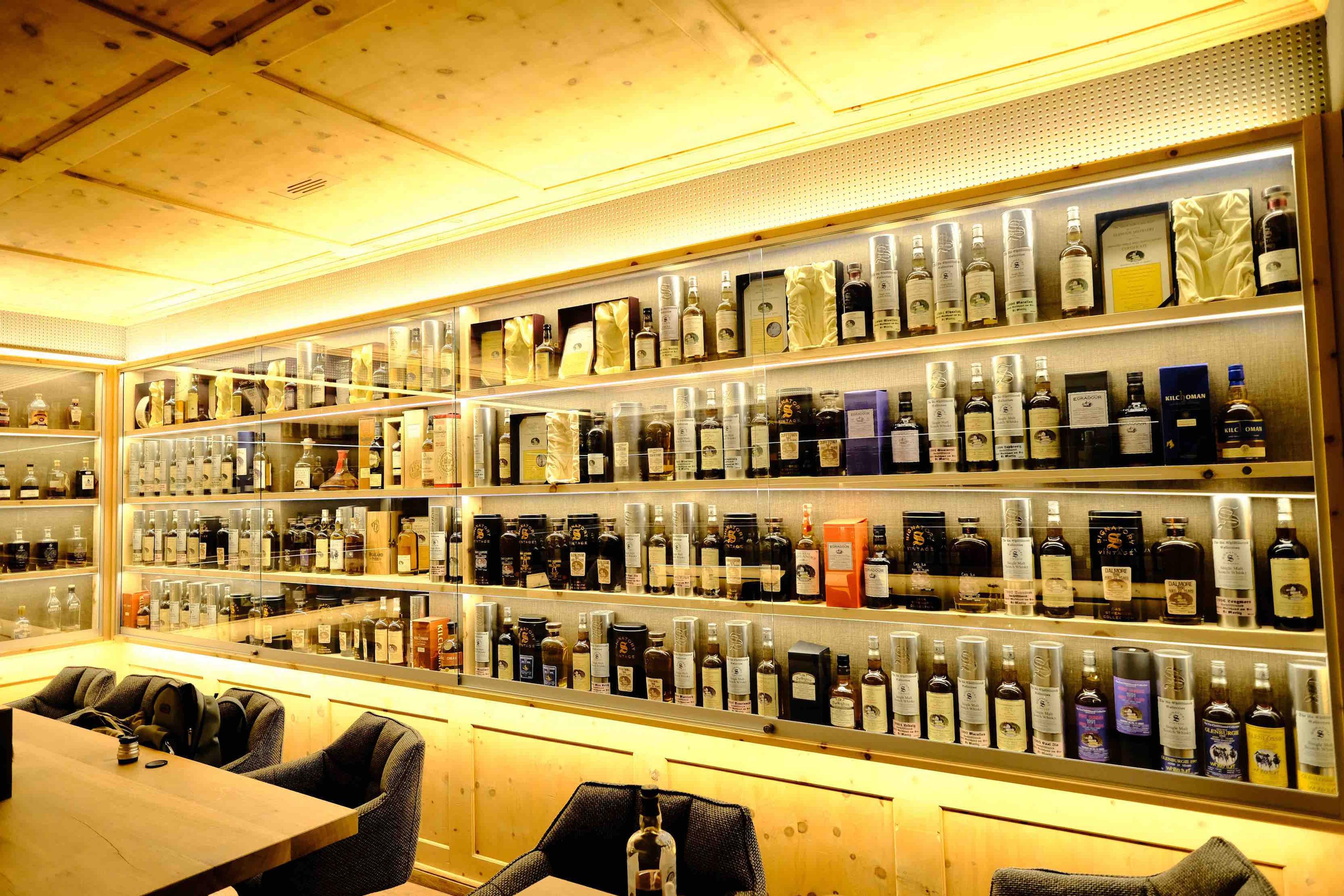
From there, we head to Tomatin’s splendid archive room, which houses hundreds of small sample bottles of their whiskies going back more than half a century.
“Every one of these bottles is a sample of everything we have in cask,” Muir continued. “Before 2010 we didn’t have this, so we had no real way of understanding what we had in our warehouses. There are ‘95s, ‘93s, ‘80s all the way down to the ‘70s. We’ve got a range of different releases here. Each one of them has different casks: your virgin oak, Oloroso, Pedro Ximénez, Mezcal, Tawny Port, Amontillado, white Port, old Claret. We like to try and experiment with different casks. Not all work but I think you’ve got to push the boundaries and see what new creations you can come up with.”
“As distillery manager, I’m here to oversee quality and make sure that continues through the years. With every release, if it sits in our warehouse for 10 or 20 years, I want you to be able to detect that the character of that spirit is still prevalent within that whisky. So we don’t want to have a full maturation of say PX for 30 years where all you get is then PX. It’s important not to over-extract things…it’s a balancing act between the spirit and the wood.”

I was lucky enough to try the 1976 from a sample bottle, and later the 1977 direct from cask.
“There won’t be many days you’ll get a whisky as old as this,” Muir smiled. “We’ve got a 1967 as well. What I think is quite unique about us is a lot of the casks were refill casks. Over the years they stumbled on the fact that refill casks are the best casks, because they’re not heavily dominant. Having been used before, the flavours really lend themselves to a long maturation. The spirit is still the dominant force through its maturation, but you get these incredible tropical notes I’ve never experienced anywhere else.”
“But nobody is going to put their spirit in refill casks as it takes so long. We still do a massive chunk of our spirit in refill casks as we know what it looks like at the end. The ’77 particularly is phenomenal – really, really tropical and heavy in pineapple.”
Castle Stuart and Old Petty - the golf connection

Castle Stuart third green with Moray Firth behind
While Tomatin’s decade-long sponsorship of the Highland Golf Links Pro-Am three-day tournament ended this year, its connection with one of the staging courses, Castle Stuart, remains strong.
“We still have an affiliation with Cabot Highlands,” [owners of Castle Stuart and its sister course Old Petty], Muir, himself a keen golfer, revealed. “A lot of people we deal with associate whisky and golf together – they go hand-in-hand and are a great pairing.”
A 50-year old Tomatin single malt, worth an estimated £10,000, was certainly a special prize for the winners of the 2021 and 2022 tournaments.
Castle Stuart, which is perched along the craggy shoreline of the Moray Firth close to Inverness, is officially a World Top 100 course, having staged the Scottish Open four times between 2011-16. Winners included Luke Donald and Phil Mickelson, with the latter claiming the Claret Jug a week later when he won the Open Championship at Muirfield.
A beautiful marriage of untamed surroundings, manicured fairways and peerless infinity greens, the course winds its way through gorse, broom, heather and marram. The views are stupendous, with ‘white horses’ waves decorating the firth on the day I played, kicked up by 25mph winds. Also visible from certain holes were the stately Kessock Bridge, the Chanonry Lighthouse and the 17th century Castle Stuart tower house.

Old Petty third hole
Old Petty, which only opened in May this year after being designed by celebrated golf course architect, Tom Doak, is right next door to Castle Stuart. Indeed, the delightful 220-yard par three third hole’s green is directly in front of the imposing tower house. It is another magisterial course, and a barely less challenging test, even if some of the holes stretch further inland and have a little more protection from the wind. Both courses share the same clubhouse, where the bar has a curated selection of Tomatin expressions and exclusive limited bottlings, such as Tomatin Legacy and special single cask editions.
Glenfarclas and the power of direct-firing

“People have characters and their character comes on the spirit," says Callum Fraser
Like Jamie Muir at Tomatin, the Glenfarclas distillery manager, Callum Fraser, is a passionate golfer, who was due to play Castle Stuart the day after I visited him. The likes of Macallan would doubtless contest Fraser’s unashamedly self-confident assertion that “I always tell people that there’s no competition in Speyside or Scotland how to make whisky – everybody just wants to be as good as Glenfarclas. So I don’t really worry about what they’re doing. I let them worry about what we’re doing.”
What Glenfarclas has done since 1983 is to employ Oloroso sherry butts almost exclusively for maturation. All come from the same bodega, Miguel Martínez in Jerez. Occasionally, the distillery matures limited edition single malts in port pipes, such as its Glenfarclas 20-Year Old Port Pipe which was released in 2023.
“We’ve got traceability in our casks as everything is hand-written and documented here,” Fraser continued, “so we know how many times it’s been filled, and what dates it was filled before. We can look at the liquid coming out of the cask, and see if it’s spent or we can use it again. So we’ve got a whole lot of traceability on site that I think other people won’t have. The casks are used four times - we’re filling 250-litre hogsheads and 500-litre butts.”
Why only Oloroso and not PX or Amontillado I ask? “Because unless somebody shows us how to improve on perfection, we won’t change,” he replied.

One other traditional production method is an unique selling-point for Glenfarclas.
“We’re the only distiller left in Scotland to direct-fire 100% of our production,” he declared. “We still have a fire underneath all of our stills, which gives us a different flavour-profile to what you get if you have an internally heated still. The direct firing gives us that nice toffee/caramel note, with dark chocolate in older whiskies.”
“The Grant family [owners of Glenfarclas since 1865] took the fires away in 1981 for three months, and decided that the spirit character had changed. They got it analytically tested, and it was clearly Glenfarclas but there were things missing. So they went back and put the fires straight back in. And they have vowed we will be direct-fired for evermore. In a direct-fired still, you get a nice caramelisation, a burning of the liquid to the copper – it gives you that nice toffee note. People who have stopped using flame have lost these notes in their whisky. So that’s unique to us, and a massive thing. We are the only distiller to do this 100% - Springbank and Glengarioch manage 50%, and Glenfiddich about 27%.”
Like Tomatin, Glenfarclas is all about people in Fraser’s view.
“This might sound silly, but I’ve been 36 years in this industry, and I think people make whisky,” he said. “We still run with people deciding on the spirit cut, looking at the temperature of the spirit, taking the feints. A lot of distilleries have moved on to the spirits cut being computerised - there’s density meters, there’s flow meters. At Glenfarclas still, there’s a man that does it.”
“People have characters and their character comes on the spirit. And the character here comes from the grandfather, John Grant, because we are the oldest family-run distillery left in Scotland. The family lives on site – Mr Grant, the chairman, is in his 70s and in his office every day. He got an OBE last month for services to the whisky industry and charity. That sums up how we are all here because we are all made to feel part of that family, and part of that band of people. People make us unique. You realise we are the best spirit in Scotland.”
Where to stay

The Dowans Hotel
Five miles from Glenfarclas on the banks of the River Spey is the historic village of Aberlour, where the Dowans Hotel is an excellent place to stay. Owned and run by the Murray family, it is a charming boutique establishment with 16 tastefully-furnished rooms. Renowned for its cuisine, it also has a famous whisky bar, named The Still, which stocks more than 750 single malts. Only a handful of labels from Scotland’s 150 or so distilleries were absent, with some international whiskies also represented.

The Still - Dowans' famous collection of 750 malt whiskies
You can taste any, or drink a special quartet put together for you. Opting for the latter, I was given four outstanding Speyside whiskies - 26-year old Imperial (from three different Bourbon casks); 10-year old Glenfiddich Century Club (a special release aged in sherry butts); Tamdhu Dalbeallie Dam (a limited release of 1,000 bottles of unspecified ageing in Oloroso casks) and Meikle Tòir (a 30ppm peated Speyside made by Glenallachie, using softer Aberdeen peat, and aged for five years in Oloroso casks).

A little further north in the centre of Elgin, another good option is the Sunninghill Hotel, which is run by the Ross family. With very comfortable rooms, a fine restaurant and a bar with 130 malt whiskies, it is walking distance from both Elgin station and the historic Glen Moray distillery, which offers an engaging hour-long tour and tasting. Founded in 1897, it produced nine million litres of spirit in 2025, although like most Scottish distilleries, output is forecast to be down by a third this year due to lower demand.
A third accommodation option is Struan House, a charming, pet-friendly bed-and-breakfast in the fishing port of Buckie 15 miles east of Elgin. Situated in Cluny Square, it is a brief hop to the harbour front and coastal walks around Spey Bay. Owners Robert and Giffie cook traditional full Scottish breakfasts of impressively wholesome quality with some exquisitely savoury haggis.